

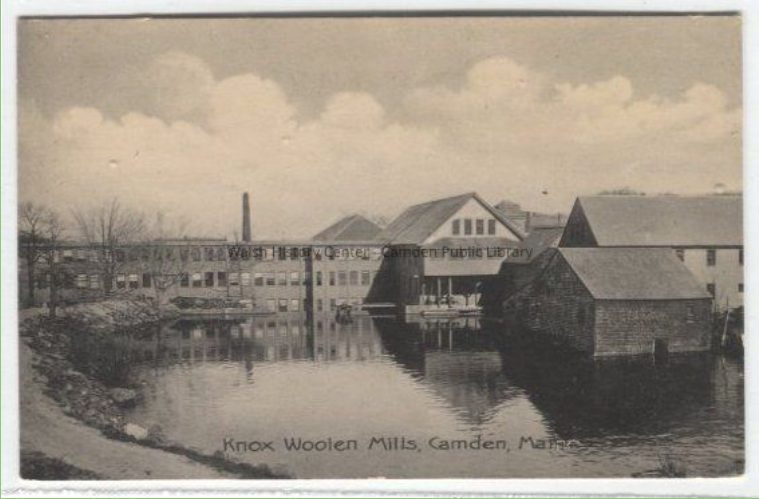
Travelers following U.S. Route 1 into Camden often have the harbor in mind. But a short walk up Mechanic Street reveals another part of the town’s story: a mill that helped supply the paper industry.
The former Knox Woolen Mill complex stands beside the Megunticook River, close to the shops and waterfront of downtown Camden. Its buildings recall a time when manufacturing was a major part of life here, and the river was a source of industrial power.
According to the Camden Public Library, the Knox Woolen Company made the world’s first endless papermaking felt and was once Camden’s largest employer. That’s a surprisingly big claim for a place many travelers know primarily for its sailboats and scenery.
Why Build a Mill Here?
The Megunticook River supplied a practical reason to build industry in Camden. Its falling water could power machinery, while the nearby harbor offered access to ocean transport.
A town study places the Knox Mill Dam roughly 980 feet upstream of Montgomery Dam, near the center of Camden. The mill’s buildings occupied a setting where moving water and manufacturing were closely connected.
You can still follow that relationship through downtown. The river runs among the buildings before reaching the harbor, linking the industrial landscape with the waterfront travelers come to see.
The Wool That Helped Make Paper
Knox’s most interesting product wasn’t a sweater or a coat. It was industrial felt used in papermaking. Camden’s Mill Walk brochure explains that these densely woven woolen materials helped separate water from wood pulp. The mill produced felts reaching 500 feet in length.
“Endless” refers to their continuous form: belts made to move through papermaking machinery. It’s an unfamiliar product today, but an essential connection between a woolen mill in Maine and the production of paper elsewhere.
National Register documentation traces production of the first endless felts to Horatio Alden and Albert Johnson in 1863. The business later became known as Knox Woolen Mill.
The early operation and the later company name are worth distinguishing. Local histories give different dates for the Knox name, so 1863 is best understood here as the beginning of the felt-making story rather than a construction date for the entire surviving complex.
Generations Behind the Looms
A mill’s history is also the history of the people who kept it running. Camden’s Mill Walk describes employees living in the Millville neighborhood and families with three generations of mill workers. These workplaces were woven into the town’s routines.
Near the end of Knox’s manufacturing years, photographer Bonnie Farmer received permission to photograph its workers, machinery, and products. Her work documented people whose families had worked there before them, preserving a record of an industry approaching its final chapter in Camden. The Camden Public Library now holds those photographs in its collections.
The Mill Closed, but the Buildings Stayed
Knox Woolen Mill closed in 1988. The property subsequently found new uses. A town study records that the former mill buildings hosted MBNA offices from 1993 to 2005 and were adapted for commercial and residential use.
The surviving complex grew in stages. Camden’s historic building inventory identifies mill structures along Mechanic Street associated with weaving, spinning, finishing, and dyeing, with dates ranging from 1863 into the early 1900s. For visitors, that means the mill is a collection of buildings with different histories, rather than one structure frozen at the moment it opened.
Why It’s Worth the Stop
Knox offers a different way to look at Camden. Walk through downtown with the town’s Mill Walk map, and the buildings begin to tell a story about the river and the industries it supported. The mapped route includes former mill structures, falls, a smokestack, and a water turbine.
Then return to the harbor. The distance is small, but the change in perspective is substantial. The same town that welcomes vacationers once depended on machinery, wool, and the people who turned raw materials into useful products.
Know Before You Go
Location: Former Knox Woolen Mill complex around Mechanic and Washington Streets, downtown Camden, ME 04843. Historic mill buildings include 39–43 Mechanic Street.
Historic dates: Endless-felt production began in 1863; the mill closed in 1988.
What you’ll find: Surviving mill buildings and an industrial history route through downtown Camden.
Access: Plan this as an outdoor, self-guided history walk. Buildings contain other uses; respect private residences and enter businesses only where public access is offered.
Cost: Viewing building exteriors from public streets does not require an attraction ticket. Parking and purchases are separate.
Time needed: Allow approximately 30–45 minutes to explore and take photographs; this is a suggested visit length.
Pro Tip: Bring the Camden Mill Walk brochure. It helps connect the Knox buildings with the river and the other industries that once operated nearby.









 Continue with Google