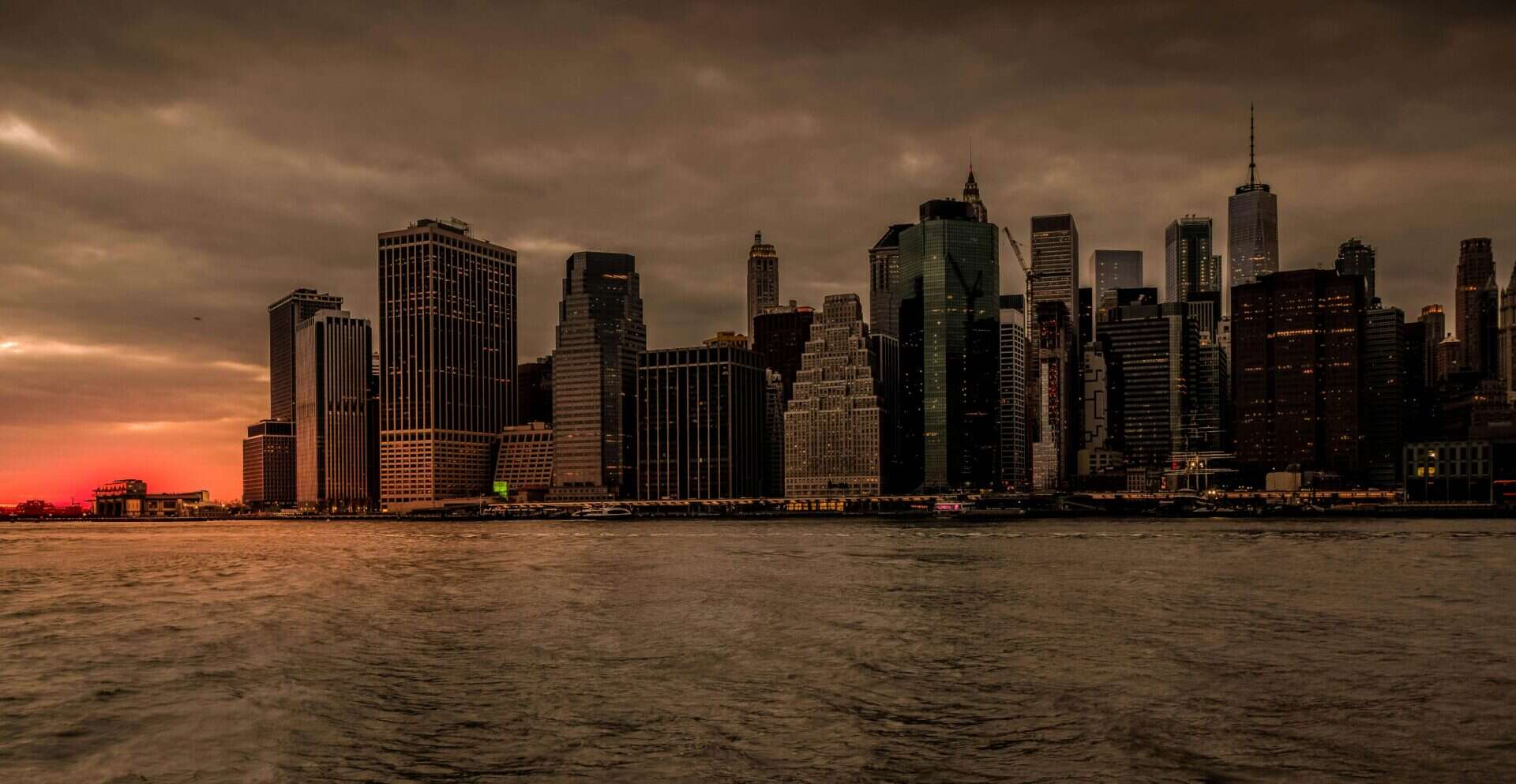
The Empire State's Many Faces
New York
New York State stands as one of America’s most paradoxical territories, a place where the world’s most famous metropolis shares borders with vast wilderness, where cutting-edge innovation meets centuries-old traditions, and where global finance rubs shoulders with small-town Americana. This is not merely the story of a city that never sleeps, but of an entire state that pulses with contradictions and possibilities.
Table of Contents
- Geography & Natural Landscape
- Historical Timeline & Key Events
- Cultural Identity & Regional Character
- Economy & Industry Evolution
- Politics & Governance
- Cities, Towns & Population Centers
- Arts, Literature & Creative Heritage
- Food Culture & Regional Cuisine
- Route 1: The State’s Eastern Thread
- Share your New York route 1 memory
- Hidden Gems & Local Secrets
- Modern Challenges & Future Outlook
Geography & Natural Landscape

Despite being one of the country’s most populous states, New York is largely rural. Forests and agricultural land cover the majority of the state.
This fundamental truth often surprises those who equate New York solely with Manhattan’s skyline. The state’s geography reads like a textbook of North American geological diversity.
Most of New York is dominated by farms, forests, rivers, mountains, and lakes.
The terrain divides naturally into distinct regions. In the north, the highest elevation in New York is Mount Marcy of the Adirondack Mountains soaring to 5,344 feet. New York’s Adirondack Park is larger than any U.S. National Park in the contiguous United States.
This six-million-acre preserve represents the largest publicly protected area in the contiguous United States, a wilderness so vast it could swallow several small states whole.
The state’s topography tells the story of ancient forces. They consist of the Highlands (Adirondack Mountains, Allegheny Plateau, Catskill Mountains, Hudson Highlands, Taconic Mountains, and Tug Hill Plateau) and Lowlands (Atlantic Coastal Plains, Erie-Ontario Lowlands, Hudson-Mohawk Lowlands, Newark Lowlands, and St. Lawrence-Champlain Lowlands).
These regions create distinct microclimates and ecosystems, each supporting different ways of life.
Waters That Define
Water shapes New York perhaps more than any other element. Some key geographic features include: More than 7600 freshwater lakes, ponds, and reservoirs. Abundant rivers and streams.
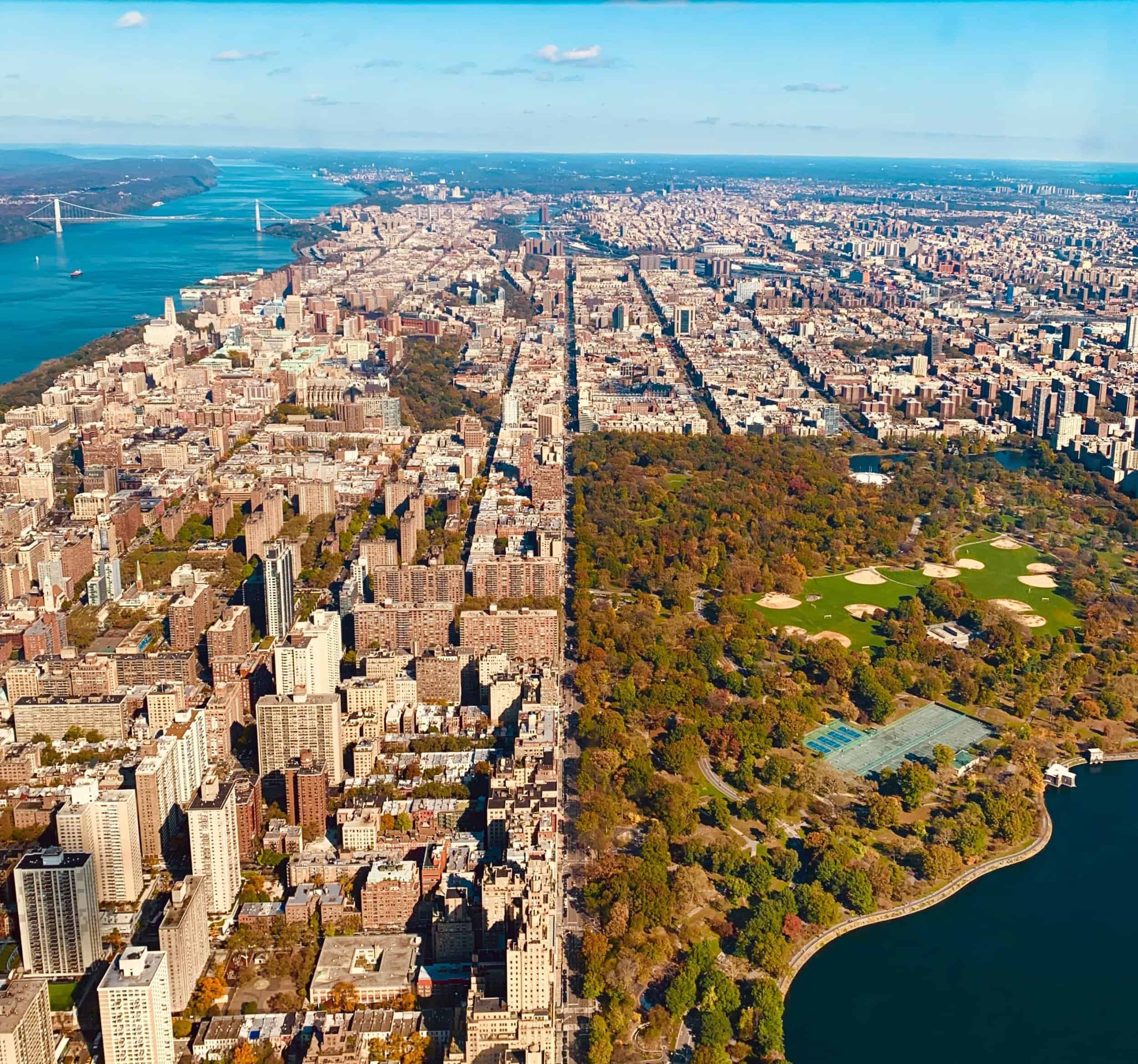
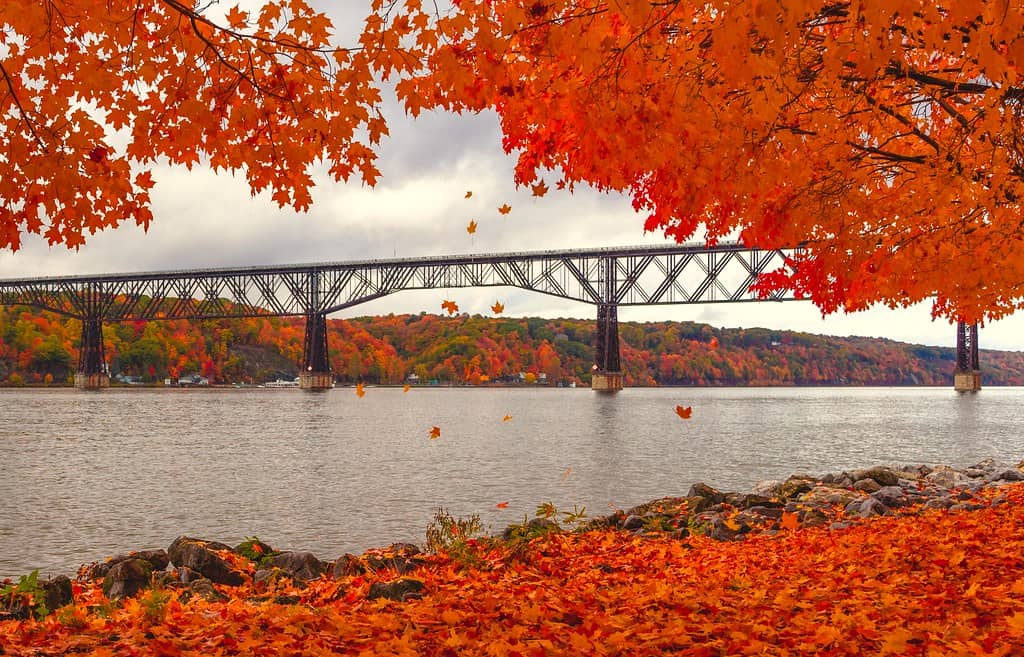
The mighty Hudson River serves as the state’s liquid spine, flowing 315 miles from the Adirondacks to New York Harbor. The Hudson River begins near Lake Tear of the Clouds and flows south through the eastern part of the state without draining lakes George or Champlain.
To the west, the Great Lakes define another boundary. Approximately 850 miles of Great Lakes shoreline, which includes the shorelines of lakes Erie and Ontario and the Niagara and St.
This freshwater coastline has shaped commerce, culture, and climate for centuries.
Climate’s Varied Moods
Most of Upstate New York is classified as humid continental in the Köppen climate classification system, while Downstate has a warmer humid subtropical climate.
This climatic division creates dramatically different living conditions across the state. Upstate New York experiences warm summers, marred by only occasional, brief intervals of sultry conditions, with long and cold winters.
The lake-effect phenomenon creates some of America’s snowiest conditions. Buffalo gets more snow than Anchorage, Alaska due to the lake effect from Lake Erie.
Towns like Syracuse and Rochester regularly record over 100 inches of snow annually, while Manhattan might see a fraction of that amount.
Historical Timeline & Key Events
The land we now call New York hosted sophisticated civilizations long before European contact. The five nations of the Iroquois League developed a powerful confederacy about the 15th century that controlled territory throughout present-day New York, into Pennsylvania around the Great Lakes.
This Haudenosaunee Confederacy created one of the world’s oldest participatory democracies, with a constitution that some scholars argue influenced the founding fathers.
Semi-nomadic Indigenous people have been living in the area now known as New York for at least 13,000 years, settling in the space around Lake Champlain, the Hudson River Valley and Oneida Lake.
These peoples developed complex agricultural systems, particularly the Mohawk cultivated maize fields in the lowlands of the Mohawk River, which were later taken over by Dutch settlers at Schenectady, New York when they bought this territory.
Dutch Beginnings
The European chapter began with exploration. European discovery of New York was led by Giovanni da Verrazzano in 1524 followed by the first land claim in 1609 by the Dutch.
But it was On September 11, 1609, the Dutch ship, the Halve Maen, entered New York Bay and sailed up the mighty river it found there. The river is known as the Hudson in honor of the ship’s captain, Henry Hudson.
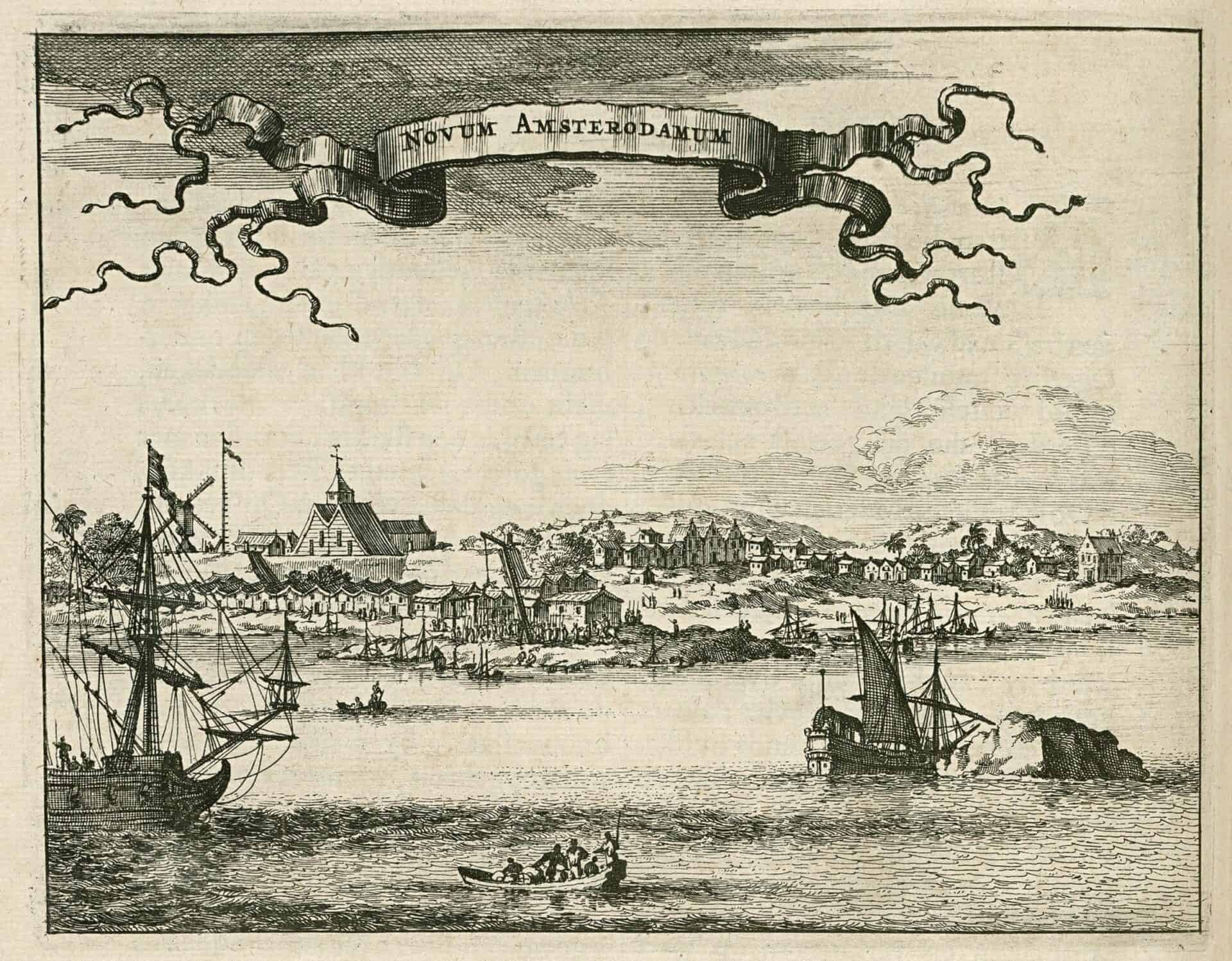
The Dutch West India Company transformed exploration into exploitation. The charter, dated June 3, 1621, gave the Company almost complete administrative and judicial power, including the power to “appoint and remove governors, officers of justice and other public officers, for the preservation of the places, keeping good order, police and justice in like manner for the promoting of trade.” By 1623, the Company had drawn up plans to settle New Netherland and the first ships, laden with colonists and supplies, arrived in the colony in 1625.
In 1614, the Dutch under the command of Hendrick Christiaensen, built Fort Nassau (now Albany) the first Dutch settlement in North America and the first European settlement in what would become New York. It was replaced by nearby Fort Orange in 1624. In 1625, Fort Amsterdam was built on the southern tip of Manhattan Island to defend the Hudson River.
English Conquest and Colonial Era
The transition from Dutch to English rule came swiftly and relatively peacefully. Dutch Governor Peter Stuyvesant surrenders New Amsterdam, the capital of New Netherland, to an English naval squadron under Colonel Richard Nicolls. Stuyvesant had hoped to resist the English, but he was an unpopular ruler, and his Dutch subjects refused to rally around him. Following its capture, New Amsterdam’s name was changed to New York, in honor of the Duke of York, who organized the mission.
In 1664, England renamed the colony New York, after the Duke of York and Albany, brother of King Charles II.
The relatively smooth transition allowed Dutch customs, architecture, and even legal traditions to persist, creating a unique colonial hybrid that would distinguish New York from other English colonies.
Revolutionary Crucible
New York’s strategic location made it central to the American Revolution. New York played a pivotal role during the American Revolution and subsequent war. The Stamp Act Congress in 1765 brought together representatives from across the Thirteen Colonies to form a unified response to British policies.
The war itself ravaged the state. British forces occupied New York City for most of the conflict, making it their North American headquarters. Meanwhile, crucial battles raged across the state: from the pivotal Battles of Saratoga, which brought French support to the American cause, to the desperate winter encampments that tested Continental resolve.
After the Constitution was ratified in 1788, New York City became the first capital of the United States. On April 30, 1789, George Washington was inaugurated as the nation’s first president at Federal Hall, located on Wall Street.
Gateway to America
The 19th century transformed New York into America’s gateway. The Erie Canal, completed in 1825, created an all-water route from the Atlantic to the Great Lakes, cementing New York City’s commercial dominance and spurring development across the state.
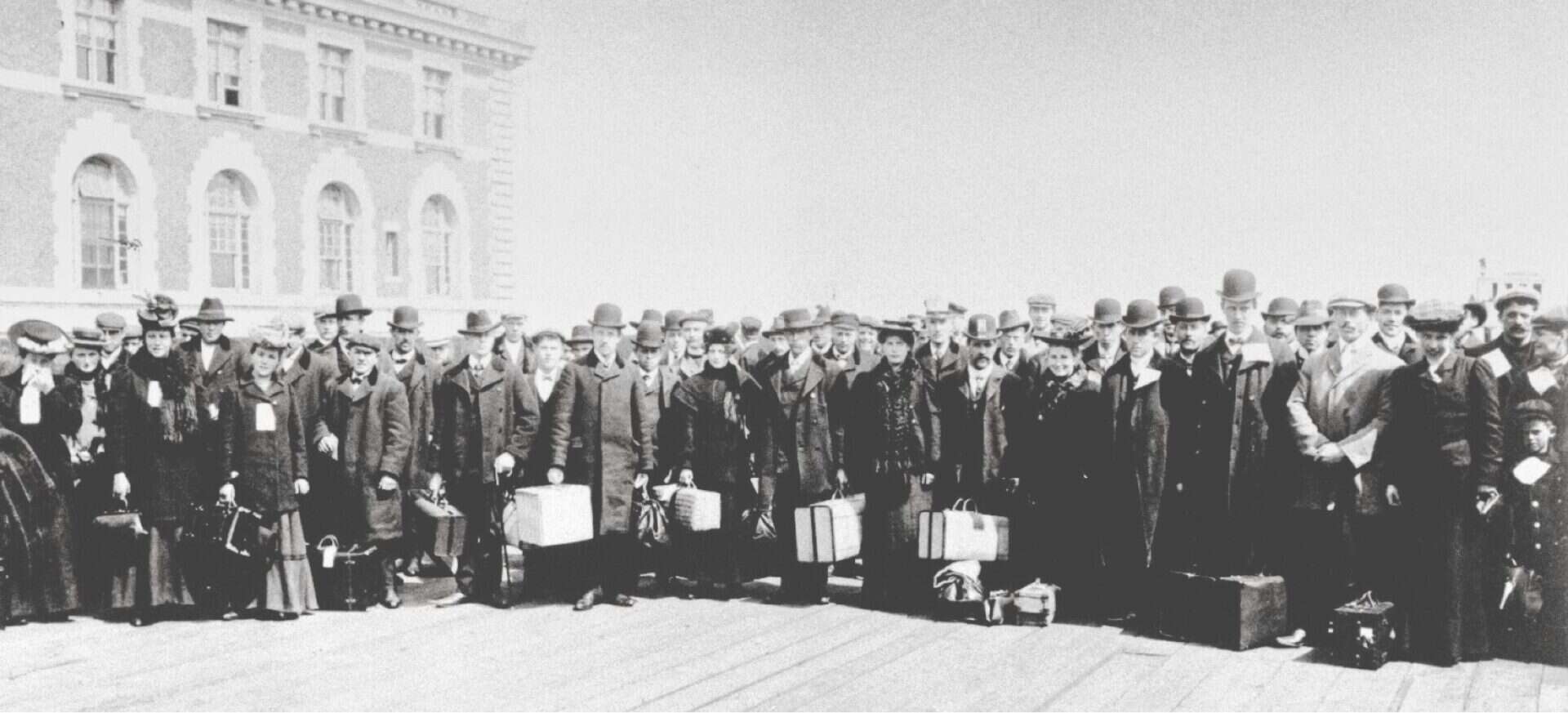
But nothing defined New York’s role more than immigration. Between 1892 and 1954, millions of immigrants arrived in New York Harbor and passed through Ellis Island on their journey to becoming U.S citizens. It is estimated that up to 40 percent of Americans can trace at least one ancestor to that port of entry.
Cultural Identity & Regional Character
The Great Divide: Upstate and Downstate
No aspect of New York’s identity generates more debate than the cultural chasm between upstate and downstate. There is no clear official boundary between upstate New York and downstate New York.
Yet the division profoundly shapes how New Yorkers see themselves and each other.
Upstate New York is a geographic region of New York that lies north and northwest of the New York City metropolitan area of downstate New York. Upstate includes the middle and upper Hudson Valley, the Capital District, the Mohawk Valley region, Central New York, the Southern Tier, the Finger Lakes region, Western New York, and the North Country. Major cities across upstate New York from east to west include the state capital of Albany, Utica, Binghamton, Syracuse, Rochester, and Buffalo.
The cultural differences run deep. Often attributed to the region’s semi-rural to rural character, there is more conservatism in culture and politics than found in the more urban downstate area, and the region is the power base of the state’s Republican Party. This political geography reflects deeper differences in lifestyle, values, and worldview.
Residents of upstate New York typically prefer to identify with subregions, such as the Hudson Valley (Middle and Upper), the Capital District, the Mohawk Valley, the North Country, Western New York or Central New York.
Each region maintains distinct characteristics. From the collegiate atmosphere of Ithaca to the rust-belt resilience of Buffalo, from the Adirondack self-sufficiency to the Capital Region’s government-centered culture.
Language and Identity
Even speech patterns reveal the divide. Upstaters might head to the “crick” (creek) while downstaters go to the shore. In Buffalo, you order “wings,” never “Buffalo wings.” In the North Country, you might hear French-Canadian influences. Meanwhile, the New York City accent (itself varying by borough) has become globally recognizable through film and television.
A cheeky joke among Manhattanites is that anything north of 14th Street is “upstate”.
This myopic view reflects the intense gravitational pull of the city, but also the genuine cultural distance between New York’s regions.
The Melting Pot Metropolis
New York City represents something unprecedented in human history; A truly global city. As many as 800 languages are spoken in New York, making it the most linguistically diverse city in the world.
This isn’t mere statistics; it’s lived reality in neighborhoods where Bengali grocers serve Dominican customers while Ukrainian landlords negotiate with Nigerian tenants.
In 2000, 36% of the city’s population was foreign-born. Among American cities this proportion was higher only in Los Angeles and Miami. While the immigrant communities in those cities are dominated by a few nationalities, in New York no single country or region of origin dominates. The seven largest countries of origin are the Dominican Republic, China, Jamaica, Russia, Italy, Poland and India.
This diversity creates a unique urban culture where authenticity paradoxically emerges from mixture. The city’s true character lies not in preservation of separate traditions but in their collision and fusion: Korean tacos, Jewish-Chinese restaurants, Italian-Caribbean neighborhoods.
Economy & Industry Evolution
From Beaver Pelts to Billion-Dollar Trades New York’s economic story begins with fur. The Dutch established New Netherland primarily as a commercial venture, trading manufactured goods for beaver pelts that commanded high prices in European markets. This extractive economy established patterns that would persist. New York as the crucial middleman between American resources and global markets.
The state’s economic evolution accelerated with industrialization. The Erie Canal didn’t just move goods; it moved the entire economic center of gravity. Cities like Troy became the “Collar City,” manufacturing detachable collars. Rochester earned the nickname “Flour City” for its mills, then transformed into “Flower City” as it became a center for nurseries and seed companies. Buffalo’s grain elevators and steel mills powered America’s industrial rise.
The Rise of Wall Street
The very first bank and stock exchange in the U.S. were actually established in Philadelphia, PA, and for a time, it was that city, and not New York, that stood as the pillar of the American financial world. Despite Philadelphia’s first-mover advantage, however, several geographic, economic, and political factors helped The Big Apple overtake the city of brotherly love to become the nation’s leading financial center.
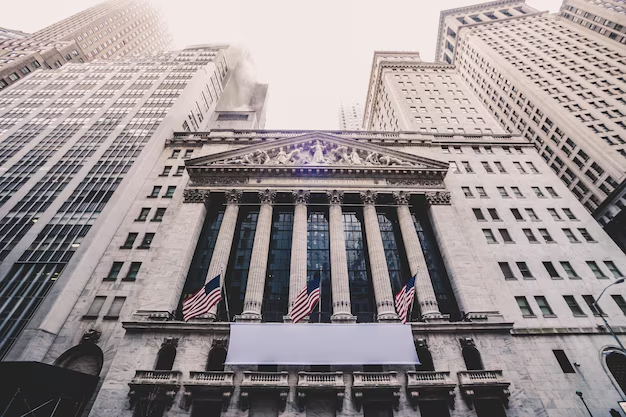
By the 1830s, having become the nation’s dominant commercial center, Wall Street was now keeping the major deposit balances of all of America’s banks. The only thing really keeping New York from claiming the title of the nation’s leading financial center was the existence of the Philadelphia-located Second Bank of the United States, whose charter was set to expire in 1836. What had become extremely irritating to Wall Street bankers was the fact that New York was the main source of Federal Customs receipts, but rather than being deposited in New York banks, they we
Today, New York City’s most important economic sector lies in its role as the headquarters for the U.S. financial industry, metonymously known as “Wall Street”. The city’s securities industry, accounting for 181,300 jobs in 2018, continues to form the largest segment of the city’s financial sector and an important economic engine, accounting for about 5% of the city’s private sector jobs in 2018, 6% (US$3.7 billion) of city tax revenue, 17%
Beyond Finance: The Innovation Economy
While finance remains dominant, New York’s economy has diversified significantly. New York is a top-tier global high technology hub. New York’s tech universe incorporates artificial intelligence, the Internet, new media, telecommunications, digital media, software development, biotechnology, game design, financial technology (“FinTech”), and other fields within inform
The development of Wall Street and the rise of prominent financial institutions have created a demand for technological innovations to increase efficiency and enhance productivity. This convergence between finance and technology has propelled New York City into becoming one of the leading global hubs for tech startups, attracting top talent and investment. With such synergy between these two industries, it is no surprise that New York continues to thrive as a major player in both finance and technology on the world stage.
The Upstate-Downstate Economic Divide
The economic disparities between regions remain stark. Downstate regions (Hudson Valley, New York City, and Long Island) consumed 66% of that amount. Upstate regions produced 50% of that amount.
Upstate’s economy relies more heavily on manufacturing, agriculture, higher education, and government employment. Cities like Syracuse struggle with population loss and industrial decline, while others like Ithaca thrive on education and innovation.
Due to its vast areas of rural land, upstate also supports a strong agricultural industry, and is notable for its dairy, maple syrup, and fruit production (especially apples), as well as winemaking.
The Finger Lakes region has emerged as a significant wine-producing area, challenging California’s dominance in certain varietals.
Politics & Governance
A State of Contradictions
New York’s political landscape defies simple categorization. While the state reliably votes Democratic in presidential elections, this masks complex regional variations. The prevailing political ethos of the residents of upstate New York varies from that of their downstate counterparts. Often attributed to the region’s rural to semi-rural character, it is more reactionary in culture and politics than the more urban downstate area, and it is the power base of the state’s Republican Party. Upstate New York, however, has several pockets of Democratic influence.
The state’s political culture blends machine politics, progressive activism, and conservative resistance. Tammany Hall may be gone, but its echoes persist in local political organizations. Meanwhile, New York has pioneered progressive policies from labor protections to same-sex marriage, often serving as a laboratory for national liberal policies.
Power Dynamics
The tension between New York City and the rest of the state shapes much of the political discourse. The sharp differences in ideology have historically fueled many political struggles by upstate conservatives with largely downstate-based Democrats in the New York Legislature, but the feuds quite often tend to be more on regional lines than on party lines. The most recent major examples were the failed attempt by the Syracuse-area assemblyman Michael Bragman, the majority leader of that body, to seize control of the downstate-dominated state Democratic Party in 2000.
This geographic tension plays out in battles over state resources, taxation, and representation. Upstate legislators complain about tax dollars flowing south; downstate politicians note that the city generates the revenue that supports the entire state. These arguments, cyclical and eternal, reflect deeper questions about identity and belonging in a state too diverse for simple unity.
Cities, Towns & Population Centers
The City That Defines Cities
New York City needs little introduction. Its five boroughs house over 8 million souls in just over 300 square miles. But understanding the city requires looking beyond Manhattan’s magnetism. Brooklyn, once an independent city, now surpasses Manhattan in population. Queens claims the title of America’s most ethnically diverse county. The Bronx gave birth to hip-hop. Staten Island maintains a suburban character despite its urban zip code.
1,606,275) is the most densely populated borough and home to most of the city’s skyscrapers. The borough contains the major business centers of the city and many cultural attractions.
Yet each borough contains multitudes. From Brooklyn’s hasidic enclaves to Queens’ Little India, from the Bronx’s Little Italy to Staten Island’s Sri Lankan community.
Upstate’s Urban Constellation
Beyond the city, New York’s urban areas each tell unique stories of American development. Buffalo, once the nation’s eighth-largest city, exemplifies both industrial decline and urban resilience. Its grain elevators, now mostly empty, stand as monuments to agricultural empire. Yet the city reinvents itself through medical research, architectural tourism, and refugees who’ve made it America’s most promising city for new Americans.
Rochester built its fortune on flour, then flowers, then film as Kodak’s headquarters. The digital revolution that destroyed Kodak devastated Rochester, but the city’s educational institutions and remaining technical expertise seed new growth.
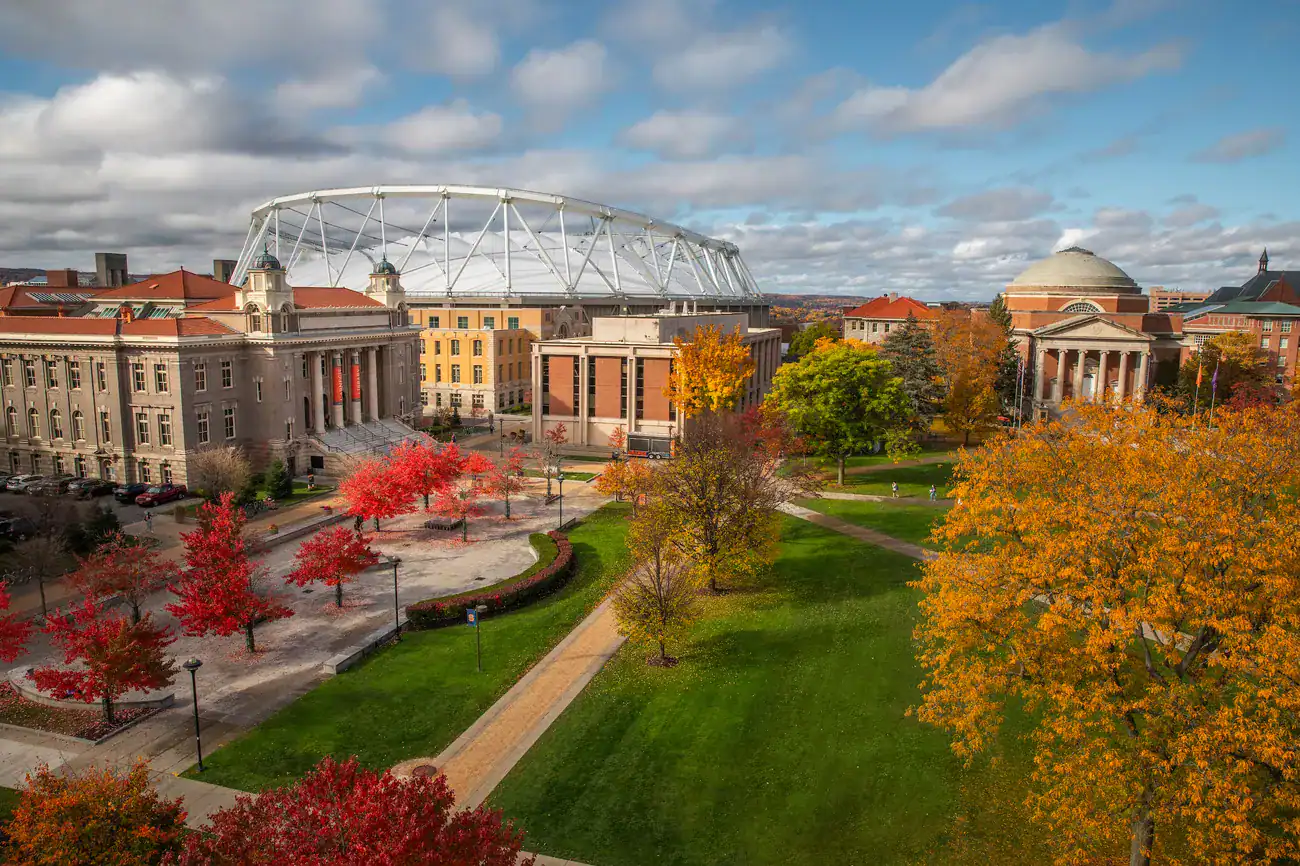
Syracuse sits at the state’s geographic heart, a salt city turned university town. Albany, the capital, blends government workers with old Dutch money and new immigrant energy. Each smaller city (Binghamton, Utica, Watertown) maintains distinct character shaped by geography, immigration patterns, and economic fortune.
Arts, Literature & Creative Heritage
The Cultural Capital
The city was the top venue for jazz in the 1940s, expressionism in the 1950s and home to hip hop, punk rock, and the Beat Generation. Along with London, New York City is the global center of musical theatre, often referred to as “Broadway” after the major thoroughfare in
New York’s cultural dominance stems from a unique confluence of factors: concentrated wealth, diverse populations, institutional support, and a critical mass of artists feeding off each other’s energy. The city doesn’t just consume culture, it manufactures it for global export.
Broadway: The Great White Way
Most Broadway shows are musicals. Historian Martin Shefter argues that “Broadway musicals, culminating in the productions of Rodgers and Hammerstein, became enormously influential forms of American popular culture” and contributed to making New York C
The Theater District represents something unprecedented: a concentrated geographic area devoted to live performance at the highest level. According to The Broadway League, shows on Broadway sold approximately US$1.54 billion worth of tickets in both the 2022–2023 and the 2023–2024 seasons. Both seasons featured theater attendance of approximately 12.3 million each.
But Broadway is more than commerce. It’s where American musical theater evolved from European operetta into a distinctly American art form. The musicals of the Roaring Twenties, borrowing from vaudeville, music hall, and other light entertainment, tended to ignore plot in favor of emphasizing star actors and actresses, big dance routines, and popular songs. Florenz Ziegfeld produced annual spectacular song-and-dance revues on Broadway featuring extravagant sets and elaborate costumes, but there was little to tie the various numbers together. Typical of the 1920s were lighthearted productions such as Sally; Lady Be Good; Sunny; No, No, Nanette; Harlem; Oh, Kay!; and Funny Face.
Jazz: America’s Classical Music
New York didn’t invent jazz, but it perfected and exported it. The city became jazz’s finishing school, where Southern musicians came to make their reputations. From the Cotton Club to Birdland, from 52nd Street to the Village Vanguard, New York’s jazz venues incubated bebop, cool jazz, and free jazz.
New York is also one of only five cities in the United States with permanent professional resident companies in all of the major performing arts disciplines: The Metropolitan Opera, New York Philharmonic, New York City Ballet, and the Public Theater. The Lincoln Center for the Performing Arts, actually a complex of buildings housing 12 separate companies, is the largest arts institution in the world. It is also home to the internationally renowned Jazz at Lincoln Center.
Hip-Hop: The South Bronx Revolution
Hip hop first emerged in the Bronx in the early 1970s at neighborhood block parties when DJs, like DJ Kool Herc, began isolating percussion breaks in funk and R&B songs and rapping while the audience danced. What began as party music in a borough devastated by disinvestment became the dominant global youth culture.
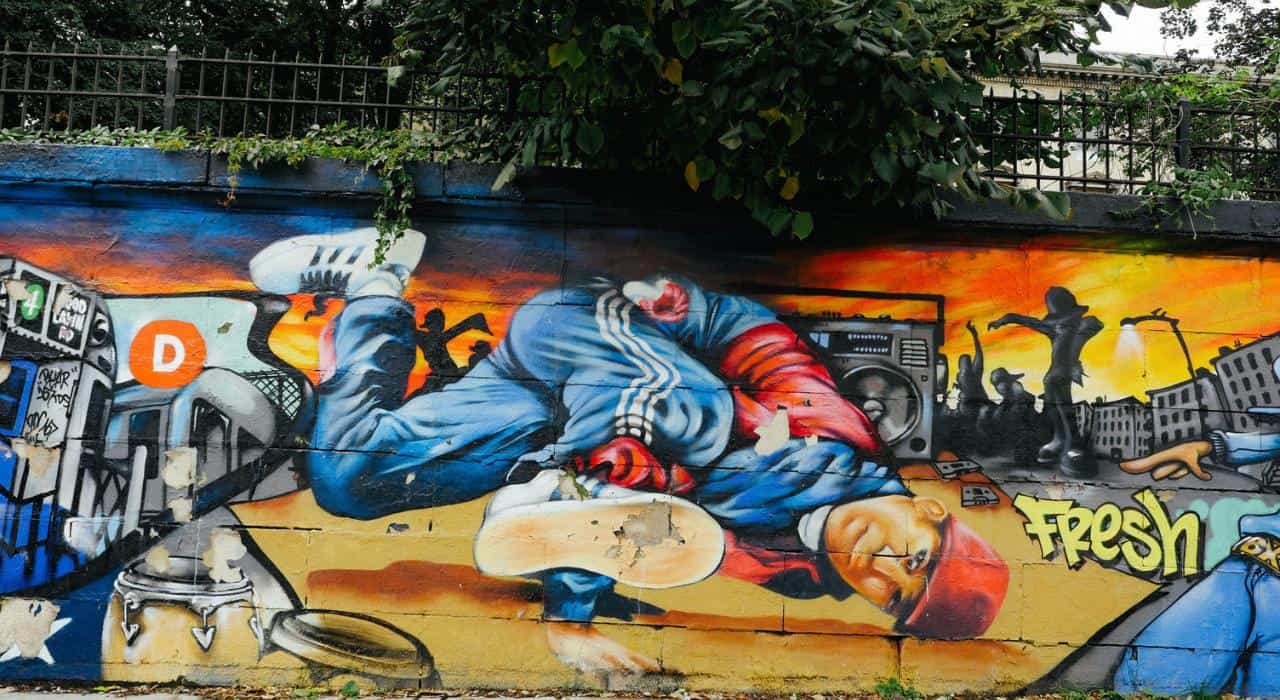
People like Kurtis Blow and LL Cool J brought hip hop to the mainstream for the first time, while so-called East Coast rap was defined in the 1980s by artists including Eric B. & Rakim, Kurtis Blow and Run-D.M.C. Major New York stars emerged to go on and produce multi-platinum records, including Puff Daddy, Jay-Z and The Notorious B.I.G., along with acts like Wu-Tang Clan, Nas, Big L, and Busta Rhymes.
Literary New York
From Washington Irving’s satirical Knickerbocker histories to Walt Whitman’s urban celebrations, from the Harlem Renaissance to the Beat Generation, New York has served as both subject and incubator for American literature. The city’s publishing houses, magazines, and newspapers created an ecosystem where writers could survive – barely – while creating lasting art.
The New Yorker magazine, founded in 1925, epitomized sophisticated urban literary culture. The Algonquin Round Table brought together wits like Dorothy Parker and Robert Benchley. Later, the Cedar Tavern and White Horse Tavern hosted Abstract Expressionists and Beat poets in alcohol-fueled artistic cross-pollination.
Food Culture & Regional Cuisine
The Democracy of Deliciousness
The cuisine of New York City comprises many cuisines belonging to various ethnic groups that have entered the United States through the city. Almost all ethnic cuisines are well represented in New York, both within and outside the various ethnic neighborhoods.
New York’s food culture embodies the city’s democratic ideals more purely than its politics ever could. A hedge fund manager and a taxi driver might stand in the same line for soup dumplings in Flushing or debate the merits of different pizza joints. Food serves as common ground in a city often divided by class, race, and language.
The Sacred Trinity: Pizza, Bagels, and Delis
Some foods have become so identified with New York that they serve as cultural shorthand. The New York slice (thin crust, foldable, often consumed while walking) represents urban efficiency elevated to art. Debates rage over coal ovens versus gas, cheese quality, and the perfect sauce-to-cheese ratio.
In New York, the bagel is still considered a Jewish bread. Across the country, they’re known as a New York food. Outside the U.S., they symbolize America, like hot dogs and pizza. It’s another example of how a lowly edible from a small ethnic enclave can become a world-famous, iconic New York (and American) food.
The bagel’s journey from Jewish staple to global commodity illustrates New York’s cultural alchemy. 36 bagel makers formed the International Bagel Bakers Union in 1907, which would rise like yeasted dough to become one of the most powerful unions in the city, especially Local 338, started by 300 Manhattan members. The Union was a “closed shop”, so only sons of members were allowed to join. Getting a bagel apprenticeship was more competitive than gaining admission to medical school.
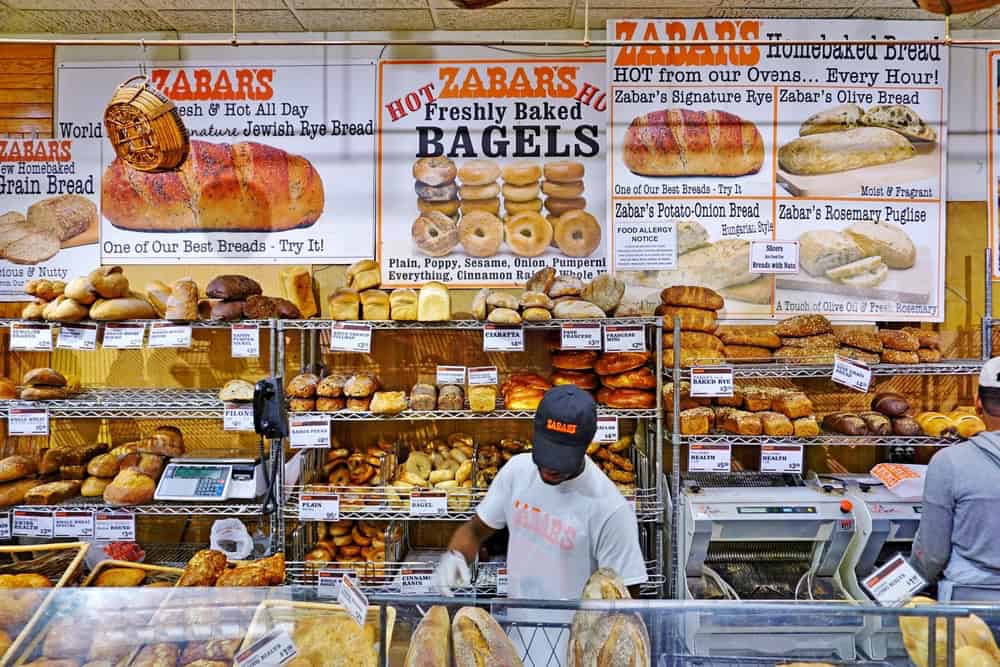
A good portion of the cuisine usually associated with New York stems in part from its large community of Ashkenazi Jews and their descendants. The world-famous New York institution of the delicatessen, commonly referred to as a “deli,” was originally an institution of the city’s Jewry.
The Transformation of Tradition
New York’s genius lies not in preserving authentic traditions but in transforming them. “The particular demographics of New York brought bagels and pizza to other groups who would otherwise never have tried them,” said New York-based food writer Frederick Kaufman. “What is happening today is one step further in the fusion of cuisines.”
Korean families now run Jewish bagel shops. J.K. Bakery, a traditional Jewish bagel shop which has been on Union Street for decades, is now owned by the Kim family. The bagels are as iconic as they’ve always been, but the faces behind this bakery’s counter are changing. New York’s food staples like pizza or bagels cannot be attributed to any demographic group anymore, said City Comptroller John C. Liu, who represented Flushing at City Council from 2001 to 2005 and is a usual customer of J.K. Bakery. “They are a part of New York now,” he said.
Beyond Manhattan’s Plates
Upstate New York maintains distinct food traditions often overlooked by food media focused on the city. Buffalo wings – never call them that in Buffalo – were invented at the Anchor Bar in 1964. The “Garbage Plate” from Rochester layers home fries, macaroni salad, and meat sauce in glorious excess. Syracuse salt potatoes, Central New York’s spiedies, North Country poutine influenced by Quebec – each region developed distinctive dishes from local ingredients and immigrant influences.
Route 1: The State’s Eastern Thread
The Historic Highway
Stretching from end to end of the thirteen original colonies, from Fort Kent, Maine, to Miami, Florida, the connecting sections of the Atlantic Coast Highway known as United States Route No. 1 have formed a highway of history for three hundred years.
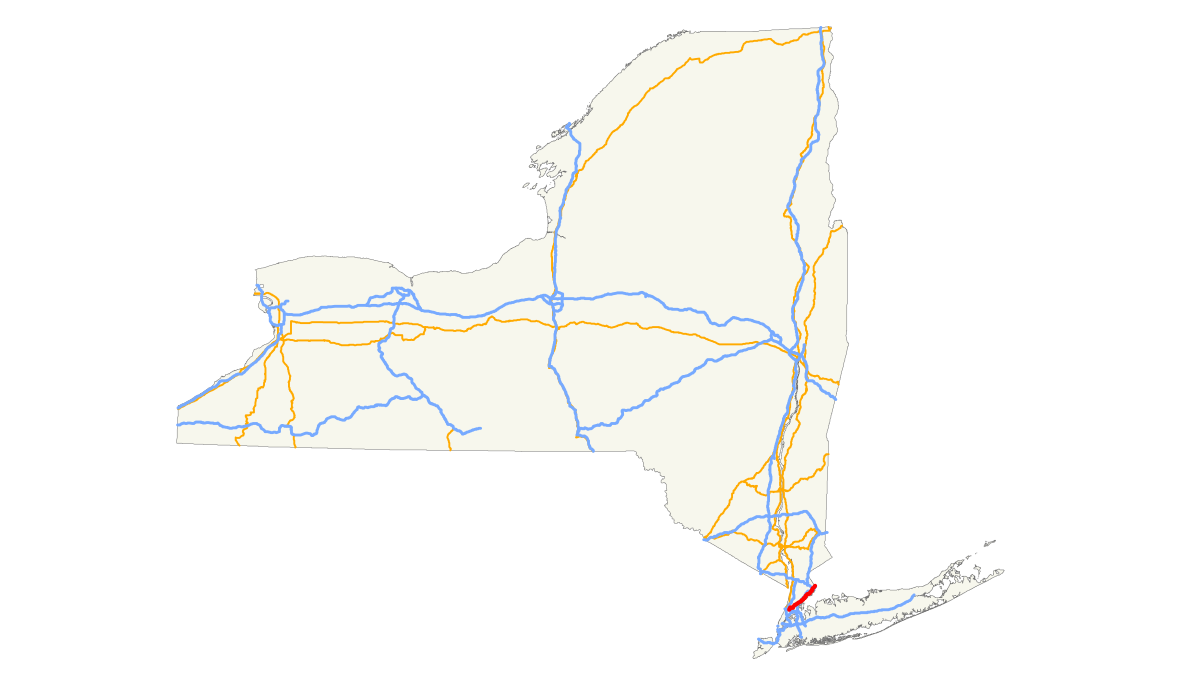
In New York, Route 1 tells a compressed version of American transportation history.
In the U.S. state of New York, US 1 extends 21.54 miles (34.67 km) from the George Washington Bridge in Manhattan to the Connecticut state line at Port Chester. It closely parallels Interstate 95 (I-95) for much of its course and does not serve as a major trunk road within the state. It is not concurrent with any other highways besides I-95 and (briefly) US 9, and few other state highways intersect it.
Following the Boston Post Road
US 1 roughly follows the old Boston Post Road, an early colonial highway between New York City and Boston originally laid out in 1673 for transporting mail and later utilized for stage coach travel. The old Boston Post Road began in Lower Manhattan and went north across the length of Manhattan. It crossed into the mainland on Kingsbridge, then continued through a largely abandoned road to Williamsbridge, then across the northern part of the Bronx along Bussing Avenue. It then continued into Westchester County along Kingsbridge Road, South Columbus Avenue, Colonial Avenue, and Kings Highway to present US 1.
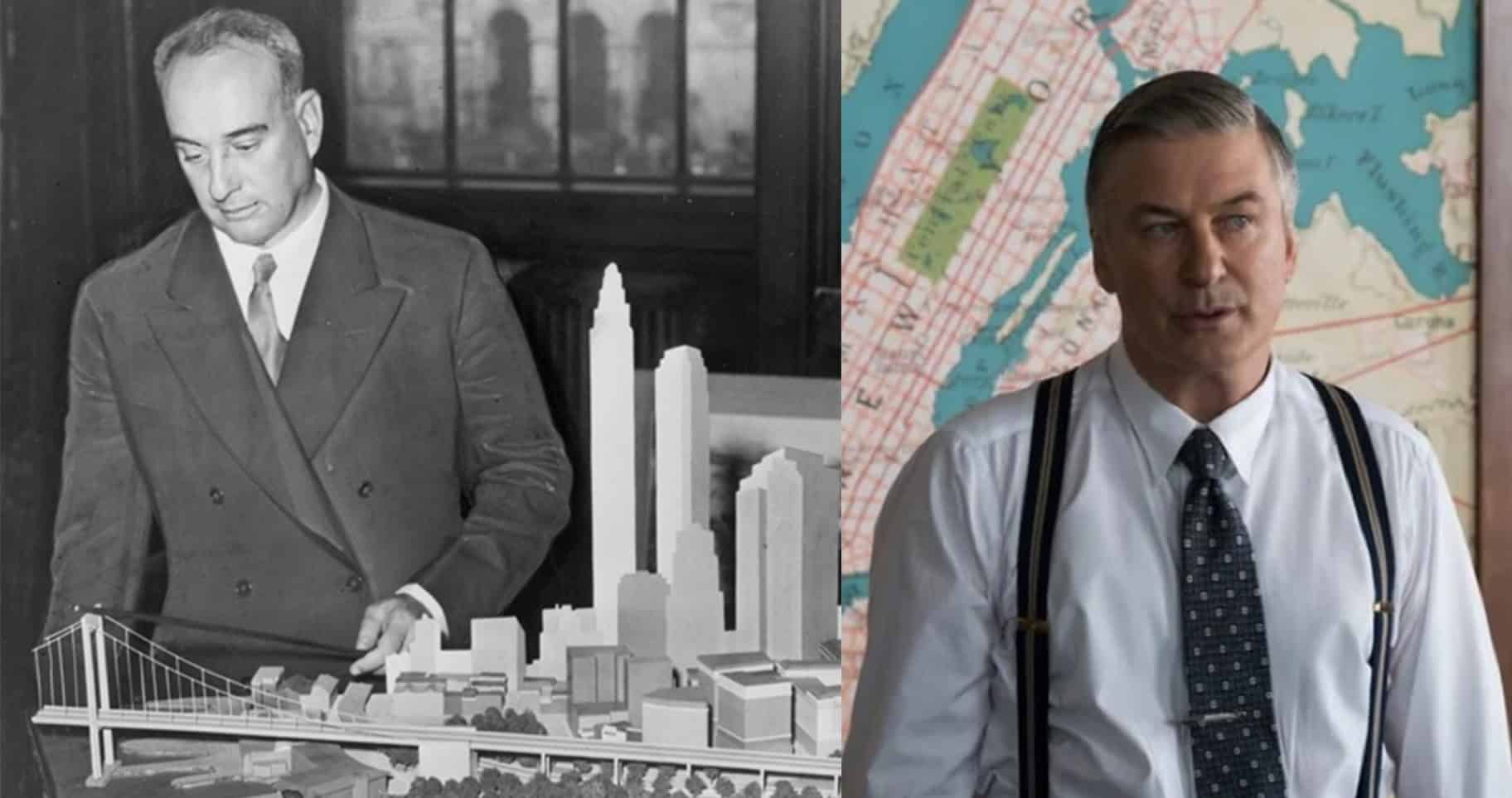
Today’s Route 1 offers a journey through time and class. Starting at the George Washington Bridge, it traverses the Bronx as the Cross Bronx Expressway – Robert Moses’s devastating slash through established neighborhoods. But then it transforms, becoming Webster Avenue and Fordham Road, past Fordham University and through the real Bronx of bodegas and botanicas.
Entering Westchester County, Route 1 becomes the Boston Post Road proper, suddenly suburban and prosperous. It travels through a variety of different terrain within the city and Westchester County, from the Cross Bronx Expressway to several important surface roads in the northwestern Bronx and then the main street of the Westchester suburbs along Long Island Sound. In many of the latter communities, it begins to intermittently follow the route of the historic Boston Post Road and often still carries that name.
Stories from the Road
Through Pelham, New Rochelle, and Larchmont, Route 1 reveals Westchester’s evolution from country estates to bedroom communities. In Rye, the Boston Post Road Historic District, a National Historic Landmark (NHL) characterized by mansions and homes that have remained unchanged since before the Civil War including the Jay Estate, Lounsberry, and Whitby Castle. The road begins to head more to the north after passing it and Rye Golf Club, to its interchange with Playland Parkway, which leads to the popular amusement park, Rye’s other NHL.
The highway’s New York stretch, though brief, encapsulates centuries of American development from colonial post road to suburban automobile strip, from exclusive Gold Coast estates to immigrant entrepreneurial energy. It’s America’s original Main Street, hiding in plain sight.
Share your New York route 1 memory
Do you have a story you would like to share? We want to hear it!
Create a View to tell a unique story about a specific place
Want to see what others wrote about New York?
Our Travel map has over 1400 posts from users like you
We have 2 types of content at Route1views:
- View: A unique experience at a single location
- Trip: A collection of experiences at different places, connected through a ‘road trip’
- Most first-time posters choose to make a View
A note about Route 1 Views
We are a user-driven social media site for celebrating and sharing stories along historic Route 1 USA. Using our platform is FREE forever and we don’t play any tricks. We don’t share your data or spam you with emails. We are all about sharing!

Hidden Gems & Local Secrets
Beyond the Postcard
While millions flock to Times Square and the Statue of Liberty, New York’s real treasures often hide in plain sight. These places reward the curious traveler willing to venture beyond tourist zones.
Urban Oases
Spread across 83 acres, the area boasts an enormous botanical garden and cultural center surrounded by cobblestone streets and Victorian and Tudor homes. One of the most popular attractions here is the Chinese Scholar’s Garden, fitted with magnificent rocks meant to resemble mountains inspired by the poetry and paintings of Confucian, Buddhist, and Taoist monks, as well as a bamboo forest path and koi pond. This describes Snug Harbor Cultural Center on Staten Island, a former sailors’ retirement home transformed into an cultural complex that most New Yorkers have never visited.
In Midtown Manhattan, secrets hide above street level. A hidden green oasis right in the Financial District, The Elevated Acre is a small park located at 55 Water Street, accessible only by an escalator. It’s a perfect spot to escape the chaos of Wall Street and enjoy a bit of greenery with views of the East River. This hidden gem includes lush lawns, trees, benches, and even a small amphitheater, making it a great place to relax or enjoy a peaceful lunch.
Acoustic Mysteries and Underground Wonders
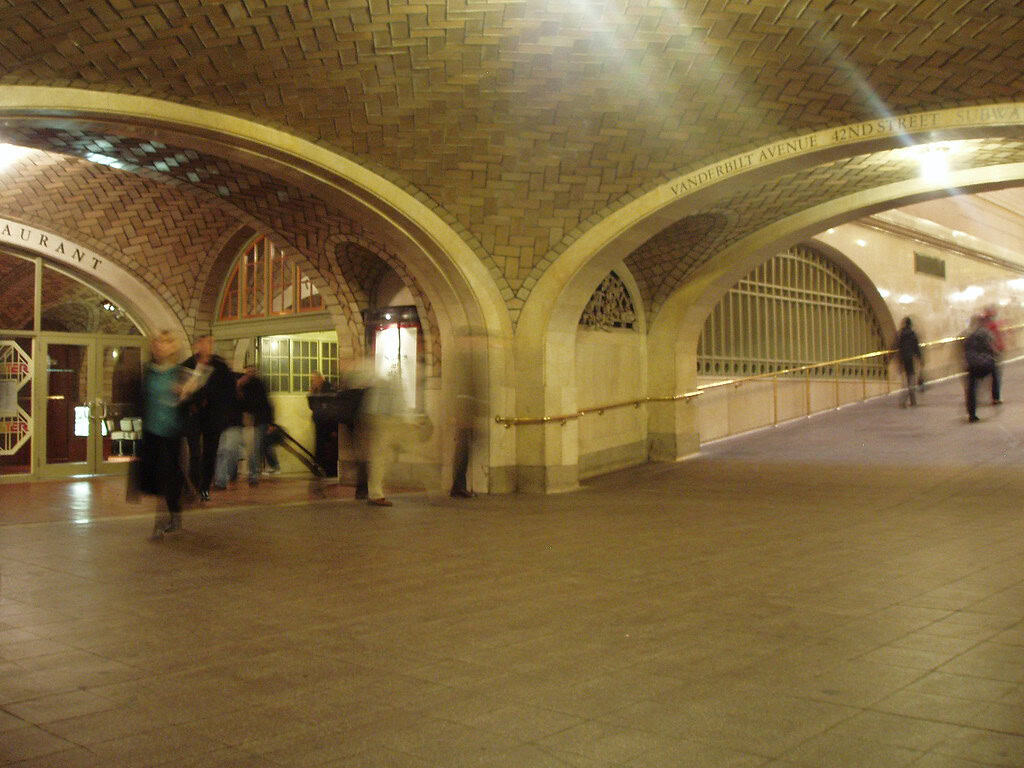
The Whispering Gallery is located near the famous Oyster Bar. Here, the acoustics of the archways create a “whispering wall” effect, where you can stand in one corner, whisper a message, and have it heard across the hall. It’s a quiet delight amid the hustle and bustle and a fascinating spot to visit.
For those seeking the macabre, To really tread off the beaten path here, though, is to head below ground to the church’s spooky candlelit catacombs. These tunnels were long closed off to the general public, but now you can book tours with the folks at Catacombs by Candlelight, who will guide you along the historic underground cemetery that acts as the final resting place of some of the oldest and most significant figures in New York history.
Upstate Escapes
Beyond the city, hidden gems proliferate. New York’s Finger Lakes region. The park’s lower part is near the village, while the upper part is open woodland. There are 19 waterfalls along its course. I believe it’s a course of 2 miles. The gorge path winds over and under waterfalls and through the spray of Cavern Cascade. Rim trails overlook the gorge.
This describes Watkins Glen State Park, where nature carved a masterpiece.
This 1.4-mile loop meanders through a heavily wooded area to an overlook facing a 150-foot waterfall. The 47 acres are set back from the small village of Philmont in the northern Hudson Valley, making this an off-the-beaten-path hidden gem. High Falls is managed by the Columbia Land Conservancy, which offers creative programming like Nature Quests.
The Quirky and Unexpected
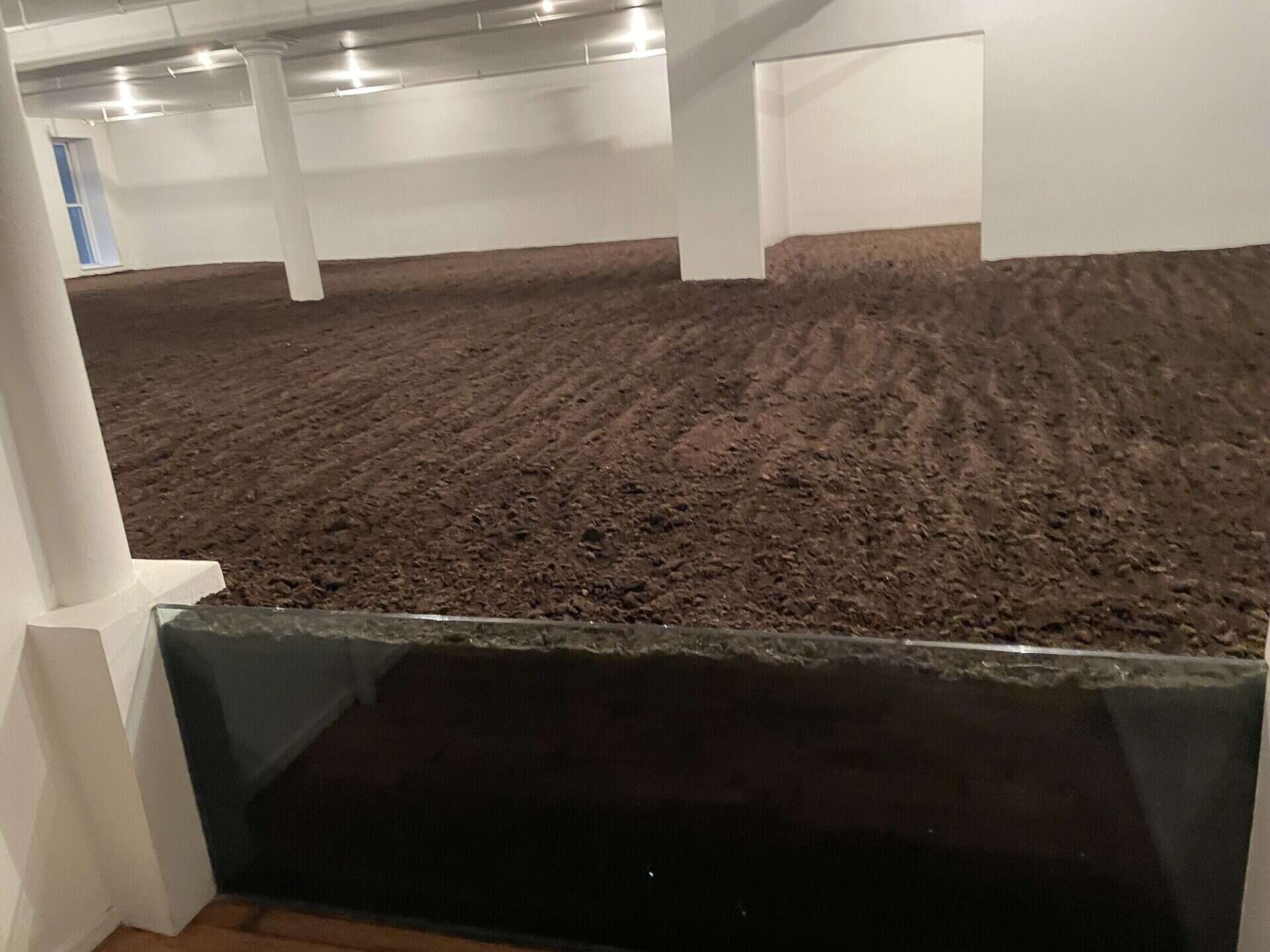
New York excels at the bizarre. In SoHo, The Earth Room – why? It’s a 22-inch-deep layer of dirt spread across a 3,600-square-foot gallery space in the middle of Soho.
Modern Challenges & Future Outlook
The Affordability Crisis
New York faces a paradox: extraordinary wealth alongside crushing costs. The median rent in January 2020 was $3,000 per month, America’s second-highest. Nor do the suburbs offer much relief: median home prices in the Tri-State area range from $471,000 to over $590,000. Meanwhile, living costs are much cheaper in Tennessee, Florida, North Carolina, and other places where finance jobs have moved.
This affordability crisis ripples through every aspect of life. Artists flee to Philadelphia or Detroit. Young families decamp for the Carolinas. Even six-figure earners struggle with housing costs. The city that once welcomed the world’s “huddled masses” increasingly serves only the wealthy.
Climate Change and Resilience
As a coastal state with significant inland waterways, New York faces severe climate threats. Rising seas threaten Long Island and the city’s extensive shoreline. This context provides a backdrop for understanding the different ways climate change is expected to affect the state and its people.
Extreme weather events increase in frequency. Hurricane Sandy in 2012 offered a preview of future challenges: flooded subways, powerless neighborhoods, vulnerable infrastructure. Upstate, changing precipitation patterns threaten agriculture while warmer winters disrupt ecosystems and winter tourism.
The COVID Reckoning
The pandemic hit New York first and hardest among American states. Early 2020 saw the city transformed into America’s epicenter, with refrigerated trucks serving as temporary morgues and nightly applause for healthcare workers echoing through empty streets.
The exodus that followed (enabled by remote work) raised existential questions. If knowledge workers no longer needed to commute to Manhattan offices, would they continue paying Manhattan prices? Then there is the looming question of remote work once the COVID-19 pandemic ends. While companies are not fleeing New York, surveys find a preference for sustained “hybrid” arrangements. If firms have fewer in-office staff on any given day, that reduces the need to maintain large offices in an expensive city.
Reinvention and Resilience
Yet New York has survived worse. The city that emerged from the 1970s fiscal crisis, the state that rebuilt after deindustrialization. This resilience runs deep. Buffalo welcomes refugees and reinvents itself as a climate haven. The Bronx sees new investment. Tech companies discover Albany. The Finger Lakes wine region matures.
In 2023, the GDP of New York City was around $1.286 trillion, of which $939 billion, or 73%, was Manhattan.
These numbers suggest continued dominance, but they mask important transitions. The future likely holds a more distributed model: strength spread across the state rather than concentrated in one borough.
The Eternal Questions
What defines New York? Is it the ambitious kid from Iowa seeking Broadway glory? The Dominican taxi driver sending remittances home? The dairy farmer in St. Lawrence County five hours from Times Square? The Seneca Nation member maintaining sovereignty in Western New York?
Perhaps New York’s essence lies precisely in its inability to be defined. It’s simultaneously America’s front door and its most unique state, the nation’s economic engine and its cultural laboratory. It contains multitudes because it must – no single story could capture its complexity.
As climate change, technology, and demographics reshape America, New York will adapt as it always has: messily, creatively, resiliently. The state that gave America the Erie Canal and the Chrysler Building, hip-hop and abstract expressionism, bagels and buffalo wings, will continue generating the new from the collision of the old.
In the end, New York remains what it has always been: a place where the impossible becomes inevitable, where ambition meets opportunity, where the world comes to become American and America comes to become worldly. It’s not perfect, far from it. But in its imperfections lie its possibilities, and in its possibilities lies its power.
The Empire State earned its nickname not through conquest but through imagination. The audacity to believe that a swampy island could become the world’s capital, that a frozen canal could unite a continent, that a democracy could contain such diversity without fracturing. That audacity, more than any building or institution, remains New York’s greatest asset and most renewable resource.