

Thousands of drivers travel U.S. Route 1 south of Richmond without realizing that a piece of early American road history is sitting practically beside them.
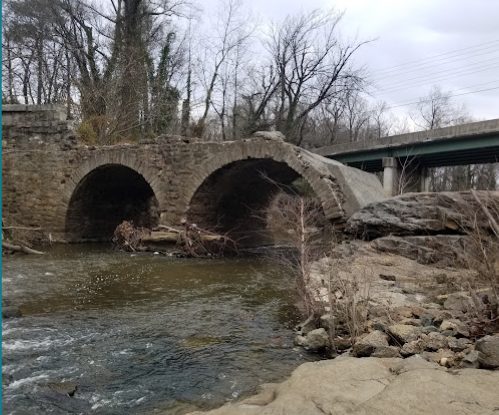
The Bridge at Falling Creek, in Chesterfield County, Virginia, dates to 1828. Built more than a century before the modern highway system, the small stone bridge once carried travelers along the Manchester and Petersburg Turnpike, an important predecessor to the transportation corridor followed by today’s Route 1. Now preserved at a roadside wayside along U.S. 1, it’s an easy place to stop and see what highway travel looked like two centuries ago.
Before Route 1
Long before numbered highways, interstates, and GPS directions, turnpikes helped connect America’s growing cities.
The Manchester and Petersburg Turnpike linked the Richmond area with Petersburg to the south. Travelers paid tolls to use an improved road that made moving people, mail, agricultural products, and other goods easier than traveling the rough roads common during the early 19th century. The Bridge at Falling Creek was constructed as part of improvements to that route.
Its builders used stone masonry to create an arched bridge capable of carrying traffic across Falling Creek. The design proved remarkably durable: more than 200 years later, the bridge remains. Virginia’s Department of Historic Resources says it is one of only about a dozen known masonry-arched turnpike bridges remaining in Virginia.
Why It’s Worth the Stop
This isn’t a giant tourist attraction, and that’s precisely what makes it such a good Route1Views stop.
The bridge offers a tangible connection between the roads Americans traveled in the early 1800s and the highway running beside it today. As transportation evolved, the old turnpike corridor continued to change. Eventually, U.S. Route 1 became the major north-south highway through this part of Virginia.
Today, cars can cover in minutes the distances that would have represented a significant journey when the Falling Creek bridge was new. And unless you know to look for it, you might never realize that the two eras of transportation history are sitting side by side.
More Than Just an Old Bridge
The surrounding Falling Creek area has its own long history.
Nearby Falling Creek was home to an early ironworks established in the 17th century, and the waterway later powered mills and other industries. Roads through this corridor connected those businesses and communities with Richmond, Petersburg, and destinations farther south.
The bridge represents more than an unusual piece of engineering. It’s part of the infrastructure that helped communities grow before railroads and automobiles transformed American transportation. In 1995, the Bridge at Falling Creek was added to the Virginia Landmarks Register and the National Register of Historic Places.
Know Before You Go
- Location: Falling Creek Wayside, Chesterfield County, Virginia
- Route 1 proximity: Directly along U.S. Route 1
- Built: 1823
- Original road: Manchester and Petersburg Turnpike
- What you’ll find: Historic masonry arch bridge and roadside historic area
- Cost: Free
- Time needed: This can be a quick Route 1 stop rather than an all-day destination.
- Pro Tip: Look at the bridge from the side rather than simply walking across the area. That’s where you can really appreciate the stone arch and the construction that has survived for two centuries.









 Continue with Google